Friday, March 8, 2013

Scribe Post 3/7


   Today Mr. O’Brien started class by reminding us that only two of us had signed up for the AP test and the rest of us should sign up soon. Then we got our supercorrection follow-up tests back and went over the problems to make sure we fully understood each one.
Follow-up test:
1. Use fnInt!
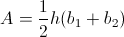
2. Use trapezoidal rule and remember the area of a trapezoid:
3. Average velocity:
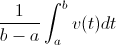
Easy mistake to make is forgetting to multiply by the fraction in front.
4. a. Find acceleration using nDeriv
   b. Total distance:
Absolute value around the function because distance cannot be negative so it makes the part of the     graph below the x axis positive.
   c. Position at t=5: use the fundamental theorem of calculus.

5. Find the antiderivative. Don't forget to add C. Check to make sure you are right by taking the derivative.
6. Find antiderivative of the function then subtract the antiderivative evaluated at a from the antiderivative evaluated at b.
7. Sketch a graph of the absolute value of x shifted to the right two and up one. Then either form two trapezoids and sum their areas or count squares.
8. Separate the integral then use the graph to integrate each and add them together.
9. Integration rules.

   After all remaining questions about the test were answered Mr. O'Brien informed us that after class on Monday we would be done with calculus! After Monday we will review up until the AP test. Before we moved onto an example problem of the new stuff we looked at number 47 from IW 1.
IW1:
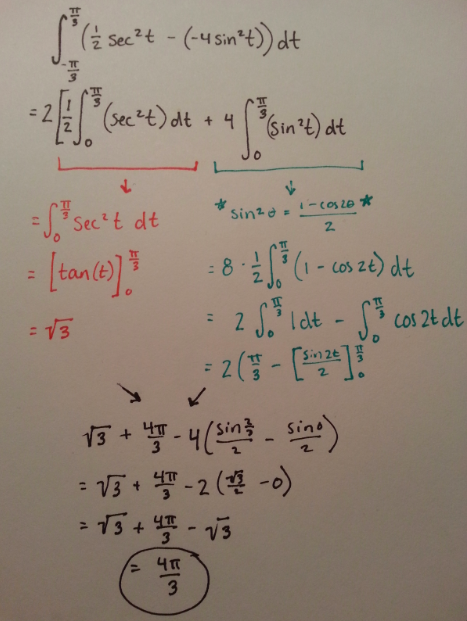
47) u substitution problem.


Area between curves:
Then we moved on to look at the first part of the new section by staring a free response question from the 2000 AP exam. In this last section we are going to be finding the area of anything whose boundary is determined by a mathematical curve. After this section we will have a way to calculate the area and the volume of objects in the real world.

This question asks us to find the area of region R which is bound by two curves.
First use a representative rectangle which is a rectangle like you would use to find a Riemann sum. Then find a function for the height of the rectangle and find a base.
Base: change in x which is known as dx.
Height: the difference between the top point and the bottom point.
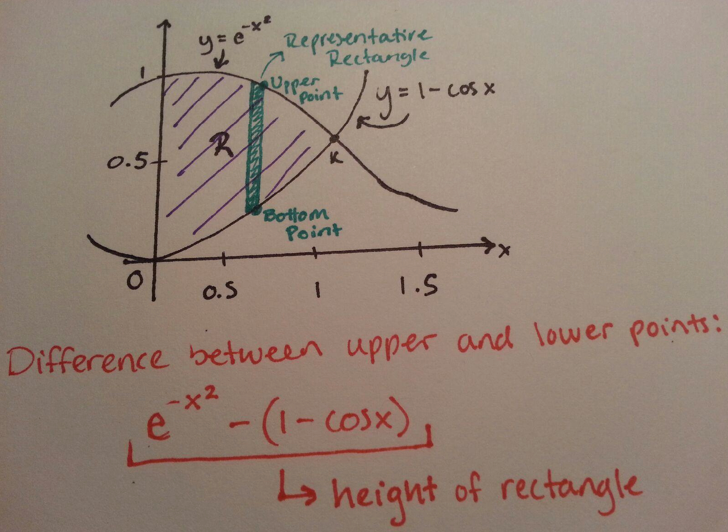

Now we sum the height times the dx from 0 to 1 and we get this integral.

Now we can use fnInt to solve this integral, giving us the area of region R.  
As long as you subtract the top from the bottom it doesn't matter what quadrant you are in, the areas between the curves will always be positive.

IW3 pg 399 Example problem for finding the area between two curves.


2) Find area of the shaded region. No technology. 
 
We do this problem the same way we did the free response problem. Find the height of a representative rectangle by subtracting top from bottom and integrating. Once we find our height function we multiply it by the base and integrate to find the area:  

This video gives a clear explanation of how to find the area between two curves as well as a demonstration on how to do it on your calculator.

IW 3 p. 399/2, 4, 10, 14
p. 401/3, 5, 13, 33, 39, 47, 49, 52, 53, 54, 55
Don't forget to post questions!
Next Scribe: ??


U-substitution practice

Practice problems with solution for u-substitution:

http://www.math.ucdavis.edu/~kouba/CalcTwoDIRECTORY/usubdirectory/USubstitution.html#PROBLEM 1

Wednesday, March 6, 2013

Quadratic Regression

Mr. O'Brien is off at the math meet. Please do p. 390/25 and 27 in class from IW #2.

Since #25 makes use of the regression calculator, please refer to these videos from Period 2:

Part 1
Part 2

I suggest watching them as a class and then referring back to them if you get stuck doing a particular step.

Monday, March 4, 2013

Scribe Post 3/1

We started off class reviewing all the material we learned throughout the year and what we have left to learn. Something important Mr. O'Brien said to note was this statement on the Fundamental Theorem of Calculus: "The definite interval of the rate of change of a quantity over an interval interpreted as the change of the quantity over the interval."(FTC):

Our new material today was "Anti-derivative by substitution of variables (including change of limits for definite integrals)"
We started our lesson by going on geogebra and making an integral (instructions below):
1. plot
2. let a=1 and make a slider
3. put a point A on the x-axis
4. type into the input: Integral[f,a,x(A)]
This is what it should look like so far:

5. plot the point (x(A),b)
(This should make a point B show up on the graph)
6. turn trace on for point B
7. move A up and down the x-axis
This is what you should see now:

The function shown in the black traced by point B is the anti-derivative of which we can figure out from the graph now to be . This is the first part of the FTC which says
G(x) being an anti-derivative of f which you can find using a constant to a variable which is what we did in geobebra above
  . If you change the constant from 3 instead of 1 (change the slider on geogebra from 1 to 3) the C value changes, in this case from -1/3 to -9. We were asked what we thought the C value would be if we changed the constant to -1 and someone guessed 1/3 which was correct! We checked our answer using the FTC:


*Note: On page 337 there a bunch of anti-derivative formulas if needing help 

Next we went into the difference between a definite integral: vs. an indefinite integral: . A definite integral is an accumulation like an area while an indefinite integral is an anti-derivative.

Mr. O'Brien did an example on the board which was to show us that the variable of integration (dx, du, whatever it may be) is important. And in order to be able to solve an integral all the variables have to be the same. We needed to know this going into integration by substitution because when substituting you have to make sure that all the variables are the same before you can solve. See example 3 on page 338.

Finally we started working on INTEGRATION BY SUBSTITUTION by doing examples from IW #1 on page 342

32.)


*sub u and du into the original integral


*sub back in what u is equal to to get your answer


34)  


 *sub in u and du into the original equation (make sure to multiply by 2 because of the 1/2 in the substitution


*sub back in what u is equal to to finish the problem


45)
*the trick with this problem is to multiply by a funny form of one:

 
*after multiply by the funny form of one we have:


*sub in u


*sub back in what u is equal to  
 

Problems 48 and 54 from IW #1 will also be finished in class, we just ran out of time to finish them today.
Just in case anyone wants to start revising for the AP Calculus test early... Mr. O'Brien suggest using  Kahn Academy

IW #1
p. 342/32, 34, 45, 48, 54 (done in class)
p. 342/5, 17, 21, 25, 27, 33, 39, 47, 55, 59, 71, 73, 76, 79