Friday, October 26, 2012

Thursday, October 25, 2012
Scribe Post 10/24
We
began class by taking our quiz on IW’s 6 & 7. Once that was done we
reviewed and praised Noah’s scribe post; “That’s what an A+ scribe
post looks like” said O'Brien with much zeal.
The main topic of today’s class was ...
Derivative of the Inverse Function
Since we already know how to find the derivative of practically every other type of function, why not inverse functions too? (I CAN THINK OF PLENTY OF REASONS TO NEVER LEARN THIS, but my opinions are not influential in the slightest)
However before we could delve into derivatives of inverse functions OB reminded us that he had posted the solutions/answers to IW#8 : https://dl.dropbox.com/u/3243156/CHRHS/apcalc/U2%20ap%20IW%20%238%20solutions.pdf
We then encountered a problem with the solution to “Negative Integers” on Question 2 of IW #8, OB said he would change it.
* It was also hinted that #3 on IW #8 could possibly be a finely crafted opportunity day question *
OKAY SO , The majestic Inverse Function
We already know that to find the inverse of a function we replace f(x) with y and solve for  . Easy peasy.
(If you want a more in-depth refresher of finding the Inverse of a function patrickJMT is your BFF)
We also know that if you graph a function and its inverse, they have y = x symmetry. These are created by interchanging the
and  values. For
example :

If you were to graph these functions it would look something like

with the diagonal y = x symmetry. At any point on the function its
inverse point on the inverse is its reflection across the y = x line.
Example : if you have a point (1, 2) inverse is (2,1).
Algebraically : If f and g are inverses then :

and if we take the derivative with respect to we get :
we get : 
which then can be rewritten as:


Next, we looked at an example. Find:


Finding the derivative of this inverse by using the Chain Rule:

where
1 is the derivative of (x -1) in the Chain Rule.
Then we plug in 2 for x, since that was the original goal (finding the derivative of the inverse function) at
x = 2 :

and if we then solve we get a lovely small answer of :

Now, let's compare this answer to the answer we would get if we used the reciprocal relationship we found above.
If (2, 1) is a point on the inverse of f , then (1, 2) is a point on f.
So,

And if we plug in 1 for  ,we get something like
and if we go back to the our first answer of

we can see that it was the reciprocal.
The key to this approach was comparing points on f and points on f'.
The key to this approach was comparing points on f and points on f'.
Next class we will learn how to find the derivative of the inverse function of at x = 3
How exciting.
And as always continue to post questions!
To do for next class : IW #9
Keep working on IW #8 and older IW
p. 169/1, 2, 4
p. 171/Exploration 1
p. 175/29b & c
#APCalculusproblems
#Whydowedothistoourselves
#O'Brienlikestomakeuscry
UPDATE:


Tuesday, October 23, 2012
Scribe Post 10/23
Today’s class began with an extremely unusual video. If anyone cares to watch it again, here’s the link: http://www.youtube.com/watch?v=CkdRVS-zKEQ Finally, we got on to doing some real math. Today’s warm-up had to with rubber-bands and the chain rule. Although it was supposed to make everyone really think, many people were simply having their own side conversations. After reading over the sheet, Hayley yelled, “I didn’t sign up for PHYSICS!” As the talking continued, Francie said something along the lines of, “Shut up! People are trying to work here.” This comment caused Elazar to say, “This is a hostile environment.” Finally, people were beginning to finish up their work. Was it a beneficial warm-up? Lexi didn’t think so, exclaiming, “I didn’t learn anything!” Mr. O’Brien interrupted the chaos in order to go over the answers for the work, but not before adding some O’Brien wisdom. “Take the opportunity to stretch your brain on these warm-ups. If you don’t engage yourself, you won’t get where you need to be in AP Calculus.”
First, he shared a cool little calculator trick. Using technology, you can use the 2nd PRGM (draw) button and then press the Tangent button to find the equation of a tangent line at a point. It’s a pretty cool trick, and what’s even better is that Period 2 doesn’t know it! In order for it to work, your calculator has to be on the graph screen. Another thing to keep in mind is, it only works for finding the equation of a tangent line. There’s no help for finding the same for a normal line. Here’s an example of this trick:
ex/  Find the equation of the tangent line at
 .
Find the equation of the tangent line at .
By graphing this equation on your calculator, you can use 2nd PRGM → Tangent at 
The equation of the tangent line is:  ! It’s that easy.
Before we started to look at the mathematical components of the warm-up, we analyzed what the different variables meant in the problem situation. The table represented a rubber band being pulled back and let go. Therefore, the x values represented the length of the rubber band. O’B pointed out that you don’t have to be a physicist to do calc! Plotting points for the graphs of x(t) and F(x) results in these two graphs: ! It’s that easy. 

When finding either
 or
 use the symmetric difference quotient, which is
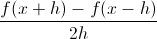 . Finding
 when
 can be done like this:

Another way to find the answer is using either the forward difference quotient,
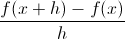 or the backward difference quotient,
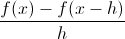 . Either approach can be used to find
 when
 . which should give you an answer of
 . By drawing tangent lines on both graphs at the indicated values, it is possible to find the slope of the tangent line, which should be the same as the answers above.
Next, we were supposed to graph
 vs.
 which should look like this:

The chain rule states that
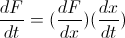 . Using this definition, we can find
 at
 :
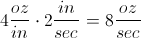
(Notice how stoichiometry is used here! Doesn’t that bring back fond memories of chemistry?) Now, let’s see if we can get the same answer using direct data:
 (again, the second values are from the symmetric difference quotient)
Geometrically, you can can use the slope of the tangent line to make sure that your answers are correct! Now, the real question is, what did you learn as a result of this warm-up?
Next on the class agenda was correcting the quiz! A simple way to answer question 1 is by using nDeriv. Otherwise, find the derivative of the function and evaluate it at
 . HINT HINT: Matching graphs will be on the next quiz! There are four things to look out for:
1. Maximum and minimum points
2. Zeroes!
3. When a function decreases, it’s derivative will be negative
4. When a function increased, it’s derivative will be positive
*Using power rules will not necessarily help you!*
Use the derivative matching game to brush up on your skills.
For number 3, the derivative gives you a slope for the point you need, but it isn’t necessary. Using nDeriv will work just as well! Once you find the slope of the tangent line, you have to find the slope of the normal line. (Remember, the slope of the normal line is the opposite reciprocal of the tangent line). Then, plug the value of  into the equation
 to find your
 value. To gain a better understanding of this, use geogebra:
into the equation to find your value. To gain a better understanding of this, use geogebra: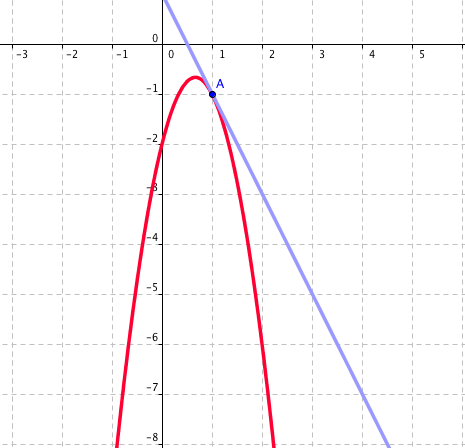
In order to completely understand question 4, you have to understand the constructs velocity, speed, and acceleration. If you’re taking physics, I’m sure Mrs. Damian had drilled these into your brain. Velocity is the derivation of position, so in order to find velocity at
 , take the derivative of
 , which comes out to be
 , evaluating at 1 will give you the velocity which is
 . When getting to the second part of this problem, some conceptual knowledge on speed is needed. Speed can never be negative, so really,
 . Remember that we are finding speed at
 , not
 . Acceleration is the derivative of the velocity function, or in the second derivative of position. Number 5 and 6 were trickier versions of concepts that we’ve been using all year. Things to remember when doing these problems are conjugate FUFOOs and algebra errors! Be very careful!
Mr. O’Brien shared a tricky way of simplifying number 7 on the quiz. The
 in the numerator and the
 in the denominator cancel to be just
 . Then, the
 reduces to be
 . What’s left is
 , which reduces to
 .
If you thought the bonus was easy, apparently it is.
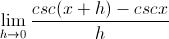 is just asking you to take the derivative of
 .

Just when you thought O’B couldn’t have packed more math into one class, he did. His new question is: Is the derivative of an odd function always an even function?
First let’s define odd vs. even:
An odd function has origin symmetry, that is:

An even function has y-axis symmetry, that is:

ex/
 is an odd function ex/
 is an odd function
 which is an even function
 which is an even function
Another example is the odd function
 , shown below:

The function above is an odd function, and when the trace function is used on geogebra, we can see that it’s derivative (the black trace parabola) is an even function. We also have to remember that functions don’t have to be even or odd, so it’s possible that the answer to the question could be “no”. With this, it’s proof time!

Check out this website if the proof above is confusing to you. It’s essentially the same thing, except that it includes a lemma and uses the
 method.
Remember!
QUIZ ON WEDNESDAY
IW #8 → Pink sheet from class
The next scribe will be Hayley. Have fun!
*UPDATE*
Mr. O'Brien noted that our class was particularly unfocused the day of my scribe post. Therefore, there was a little change to our 40 minute period. Instead of asking IW questions, we caught up on two problems which were we supposed to take notes on yesterday. The first problem was:
ex/ Find the equation of the tangent to a circle centered at the origin with a radius of 4 when  and
 is positive.
and is positive.
First, we will look at this problem geometrically:

Next, we must look at the problem algebraically, to see if the answer is the same:

We do! But, as O'B pointed out, it's much less work getting the answer geometrically. If you understand that approach more, great! It means much less work.
The next problem that we were given was finding the equation of a normal line at  with the equation
 . The work for this problem is as follows:
with the equation . The work for this problem is as follows:
Subscribe to:
Posts (Atom)